
The Zero-Click Cliff: Searching in the Era of SGE
Imagine a business owner in Toronto named Sarah. Sarah runs a successful software company. For years, she worked hard to make her website show up on the first page of Google. She was happy because when people searched for “team management tools,” her company was always a top result.
But recently, Sarah noticed something terrifying. Her traffic was dropping, and she didn’t know why. She decided it was time to find a professional partner to help her navigate these changes.
She went to Google and typed in a search that thousands of North American CEOs are typing right now: “How to compare SEO agencies in Canada.”
Sarah expected a list of websites she could research. Instead, she was met with a massive, colorful box that pushed every single agency website off her screen. This is the Google AI Overview (also called SGE).
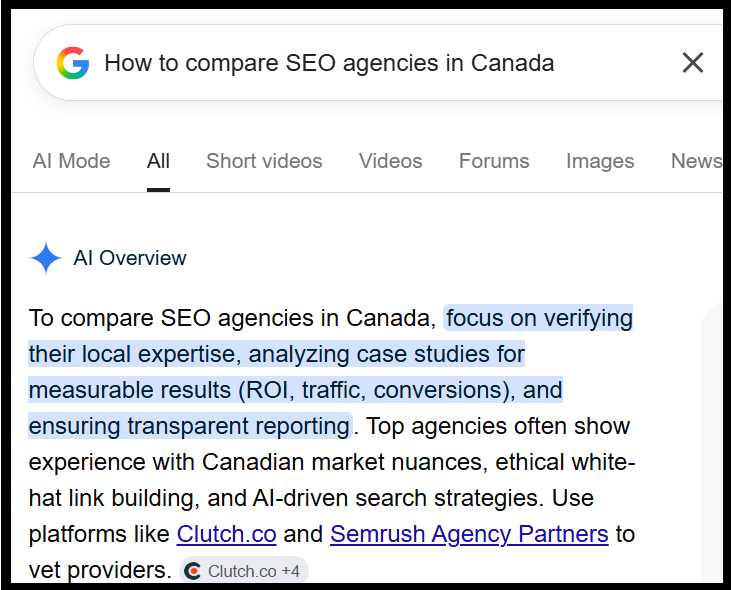
Inside this box, Google’s AI answered Sarah’s question directly. It told her what to look for in an agency, which standards to check, and even mentioned specific Canadian nuances—all without Sarah ever needing to click on a single agency’s website. At Go Rank High, our mission is to show you how to become that Source of Truth so that when the AI speaks, it speaks your name.
How the Machine Thinks: The Engineering of Selection
When our technical lead, Taimoor, looks at a Google search page, he doesn’t see marketing text; he sees a complex engineering system. To win the AI Overview, you have to understand how the machine “thinks.” After establishing this technical foundation, our team handles the heavy lifting of structural optimization.
Retrieval-Augmented Generation (RAG)
Google’s AI uses a process called RAG. Think of it like this: the AI is like a super-librarian. When a user asks a question, the librarian doesn’t just guess the answer. Instead, they quickly run through the library, find the three most trusted books, read the relevant pages, and then summarize the answer for the user.
To be the “book” that the librarian picks, our technical framework ensures your website is:
- Technically perfect (so the librarian can read it fast).
- Factually accurate (so the librarian trusts the data).
- Semantically clear (so the librarian understands exactly what you are saying).
Semantic Proximity and Entity Salience
Our engineering-led approach focuses on “Entity Salience.” In simple terms, an Entity is a “Thing” (like your brand, your city, or your specific service). Salience is how important that thing is to a specific topic.
If a user in New York searches for “commercial plumbing,” Google looks for the “Entity” that is most closely related to that topic in that specific city. By building a website structure that clearly defines your brand as the “Master Entity” of your niche, our technical team makes it easy for the AI to choose you as the source of truth.
The Art of Being Citable: Our Strategic Perspective
While the technical side makes your site readable, our strategic lead, Ammara, ensures your site is “citable.” Her strategy bridges the gap between raw data and human trust. Beyond this initial strategic setup, our Go Rank High framework takes over the content execution.
Information Gain: The AI’s Favorite Meal
Google’s AI is looking for more than just a “good” blog post. It is looking for an Authoritative Answer. In a world where millions of people are using AI to write the same generic content, our strategy focuses on a new favorite metric: Information Gain.
As we detailed in our E-E-A-T checklist, Information Gain is the addition of new, unique facts or expert opinions that don’t exist anywhere else on the web. If you write a blog post that says exactly what your competitors say, the AI has no reason to cite you. But if you provide a unique case study, a real expert interview, or a proprietary data point, the AI sees you as a “Source of Truth.”
Corroboration: The Web of Trust
The AI doesn’t just trust you because you say you are an expert. It looks for Corroboration. This means it checks other reputable websites—like LinkedIn, industry-specific journals, and local North American news outlets—to see if they agree with you. Our methodology focuses on building this “Web of Trust.” We ensure your brand’s expertise is echoed across the entire internet, making it impossible for the AI to ignore you.
The Anatomy of an AI Overview: Breaking Down the “Source Carousel”
To dominate the future of search, you have to know what you are aiming for. When you look at an AI Overview, there are three main parts where your brand can appear.
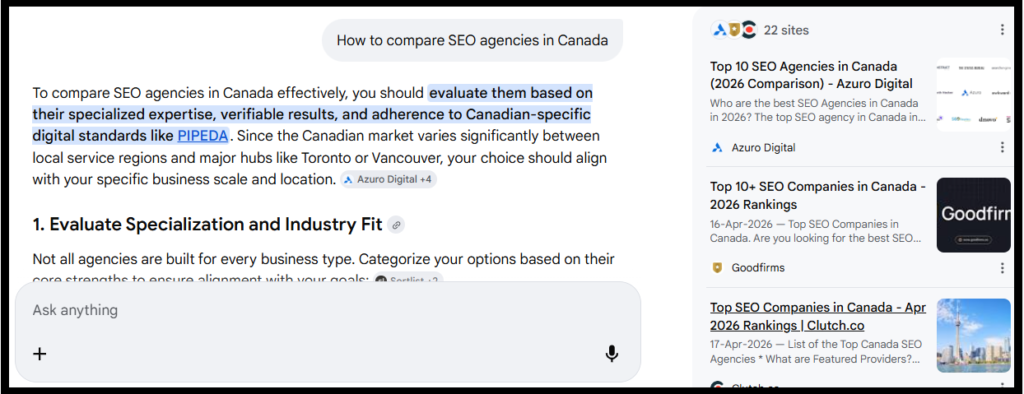
1. The Synthesis (The Main Text)
This is the text the AI writes to answer the user’s question. To be included here, your content must satisfy AEO (Answer Engine Optimization). Our framework ensures your answers are direct, clear, and objective.
2. The Carousel (The Primary Citations)
These are the cards you see on the right side of the box (as shown in Pic 2). These are the “VIP” spots. To get here, our technical team uses our GEO Specialist framework to tell the AI exactly which part of your page has the answer it needs.
3. The Citations (The Internal Links)
Sometimes, the AI will put a little number or a link directly inside the text it writes. To get here, your content needs Information Gain. You need to have said something so unique and valuable that the AI feels it must give you direct credit.
The 5-Step SGE Domination Framework
How do we take a brand from being “just a link” to being the “Answer”? We follow a strict 5-step engineering and strategic framework.
1. The “Answer Block” Implementation
We don’t start our articles with 500 words of “fluff.” We implement what we call an Answer Block. This is a short, 40-word summary at the very top of your page that provides a direct answer to the user’s most likely question. AI crawlers love these blocks because they are easy to “scrape” and use in the Overview.
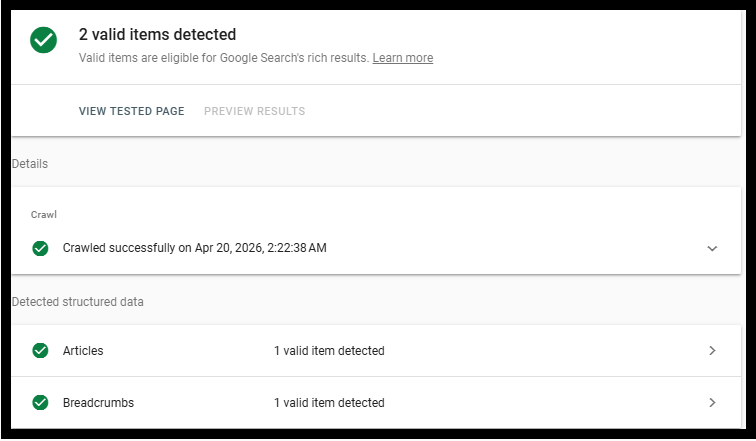
2. Technical Entity Mapping (Schema)
As we explained in our GEO vs SEO Blueprint, our team uses engineering-grade JSON-LD Schema. This is a special type of code that acts like a digital ID card for your business. It tells Google: “This brand is a verified expert, located in Toronto, with these specific certifications.” Without this, the AI might see your text but won’t know if it can trust the person who wrote it.
3. Proprietary Data Injection
We never just “rewrite” what is on the web. We use Subject Matter Expert (SME) Interviews to find original data and real-world stories. By adding unique facts, we trigger the “Information Gain” signal that Google uses to choose its citations.
4. Semantic Clustering
We don’t just write one blog post. We build Power Hubs. Our framework links 10 or 20 related topics together so that Google sees you as an authority on the entire subject, not just one keyword. This makes you a “Topical Authority.”
5. Cross-Platform Corroboration
We ensure your brand is mentioned on high-authority North American sites like LinkedIn, industry boards, and local news. This proves to the AI that the “rest of the internet” trusts you, which gives the AI the confidence to recommend you to the user.
The Search Intelligence Briefing: Hard Truths About AI Overviews
As we navigate the SGE transition for our clients in the USA and Canada, we get many questions from business owners. Here is our perspective on the most common AI search queries.
How do I rank in AI Overviews?
How do I rank in AI Overviews?
To rank in AI Overviews (SGE), you must provide a clear, direct answer to a user’s query within the first 100 words of your section. Use structured data (Schema) and ensure your brand is cited on reputable third-party sites to prove your authority.
Does the AI Overview favor big brands over small, niche businesses?
Many people worry that big companies with huge budgets will always win. However, in the era of AI Overviews, Niche Authority is more important than budget. If a big brand provides a generic answer but you provide a specific, expert-led, and technically structured answer, Google’s AI will often cite you as the “expert source.” This is the first time in history where a small business can out-rank a giant by simply being “smarter” with their data.
What happens to my Click-Through Rate (CTR) when the AI answers the question directly?
It is a hard truth: your clicks on generic, “Top of Funnel” keywords will go down. If someone just wants to know “what is SEO,” they will read the AI box and leave. However, the clicks you do get from the AI citation are much higher quality. These are High-Intent Buyers. They have already been convinced by the AI that you are the expert. You may get fewer clicks, but those clicks are 5x more likely to turn into a phone call or a sale.
How does Google decide which three sites get into the “Source Carousel”?
Google’s AI looks for Corroboration and Authority. It asks a simple question: “Is this website technically sound and does it provide unique, trustworthy information that is verified elsewhere on the web?” The sites that provide the best “Information Gain” while maintaining perfect technical health are the ones that get the primary spots in the carousel.
Can I “block” AI from using my content to protect my website traffic?
You can use a technical file called “robots.txt” to tell AI bots not to read your site. But at Go Rank High, we believe this is a strategic mistake. If you block the AI, you aren’t “protecting” your traffic; you are removing yourself from the future of search. If the AI can’t see your expert advice, it will simply cite your competitor instead. To win in 2026, you must be the source the AI wants to use.
Is voice search (like Siri or Alexa) the same as a Google AI Overview?
Technically they are different, but they share the same “Answer Engine” roots. When you optimize your site for AEO (Answer Engine Optimization), you are making it easier for both a screen-based AI and a voice assistant to find your answer. Our strategy ensures that whether a user is looking at their phone or asking a question while driving, your brand is the definitive answer.
How do we measure “Share of Model” as a new ROI metric?
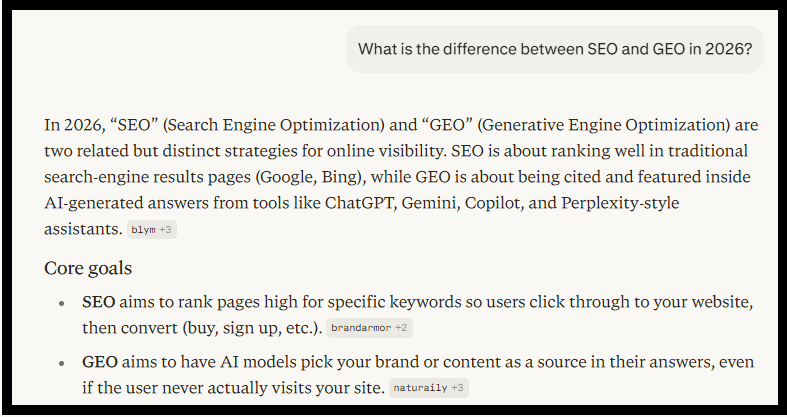
In the old days, we tracked “Keyword Rankings.” In 2026, we track Share of Model. This means we measure how often your brand is cited as a source across different AI platforms like ChatGPT, Gemini, and Perplexity. If the AI models are recommending you to users, your “Share of Model” is high, which leads to long-term brand authority and revenue growth.
Dominate the Answer, or Disappear
The search landscape of 2026 is no longer about who can buy the most links or who can write the most words. It is about who can own the answer.
Sarah the software CEO survived because she stopped trying to “trick” Google and started trying to “teach” Google’s AI why her software was the best. She moved from being a “result” in a list to being a “Source of Truth” in the AI box.
At Go Rank High, we combine the precision of engineering with our unified growth strategy. We don’t just want you to rank; we want you to be the definitive answer. Our technical framework builds the “Nervous System” of your site, while our strategic approach builds the “Heart” of your content.
Is your brand the definitive answer, or just a noise in the background?